This is a "commonplace notebook" of sorts, where I collect passages, observations, and ideas
I want to hold on to. Inspired by Steven Johnson, Anne Lamott, and
James Somers. This rendering, however, was inspired by Jeff Fossett.
I married my wife a few months ago, in December of 2025. It was a small ceremony at the Broward County Courthouse with my parents and Megan's mom as the witnesses.
Friends have since asked "how does it feel?" or, more specifically, "does it feel any different?" They ask because my wife and I have been together for a while, basically the entirety of my PhD (and the entirety of hers). We've lived together on and off during this time, moving with COVID and spending time apart because our research programs were states apart. By my mom's account "hate to break this to you, but you've been married and didn't know it."
It's true that it mostly feels the same, but there's at least one thing that feels fundamentally different and it's something no one ever told me and I never thought to ask. Though once I say it aloud, it's rather obvious. So I've devised a simple thought experiment to illustrate.
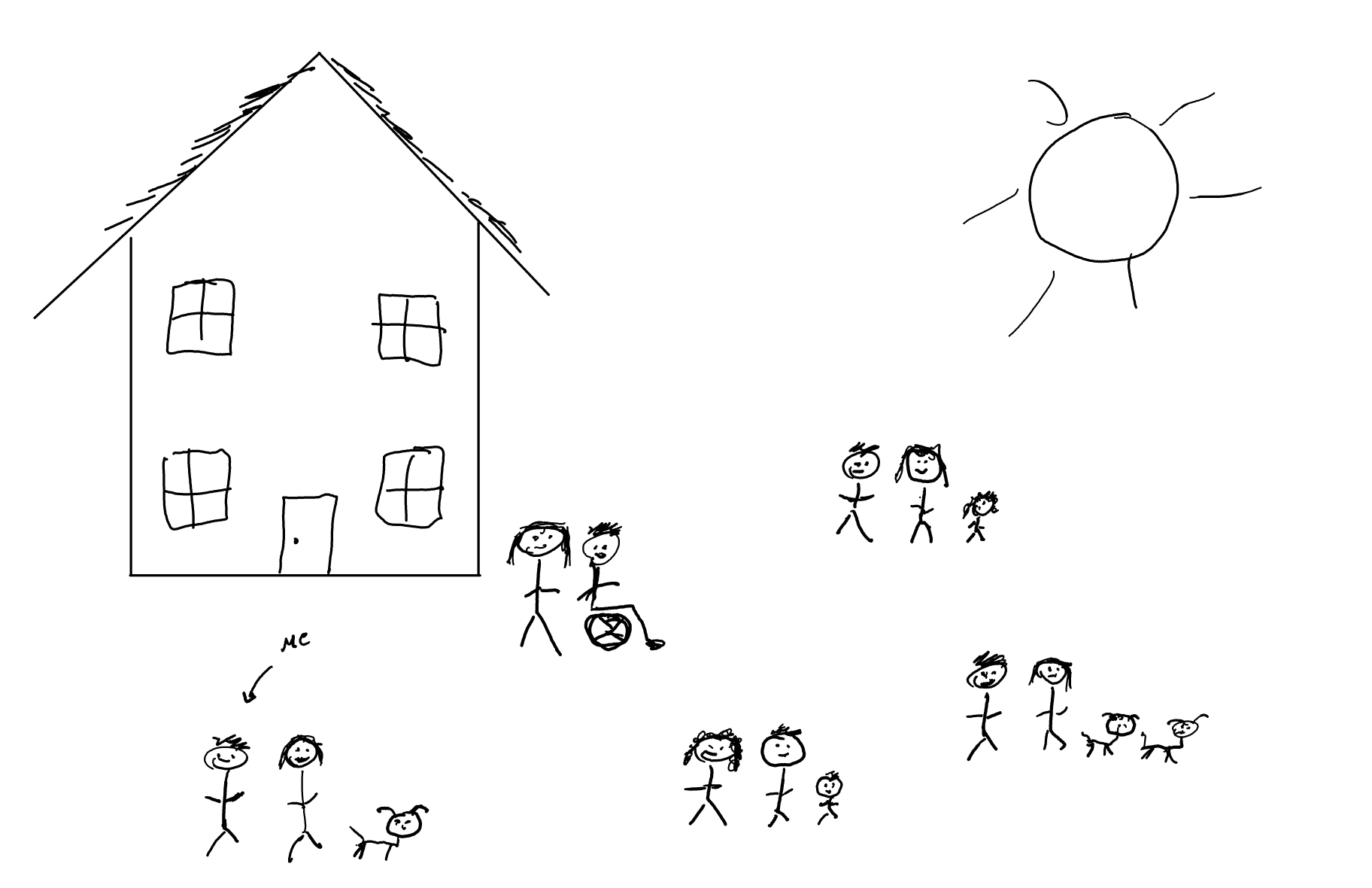
Imagine being asked to "draw your family," whatever that means to you. How would you do it?
You can do it here (or draw it on a napkin and upload the photo):
Scroll down to see how I would do it.
↓
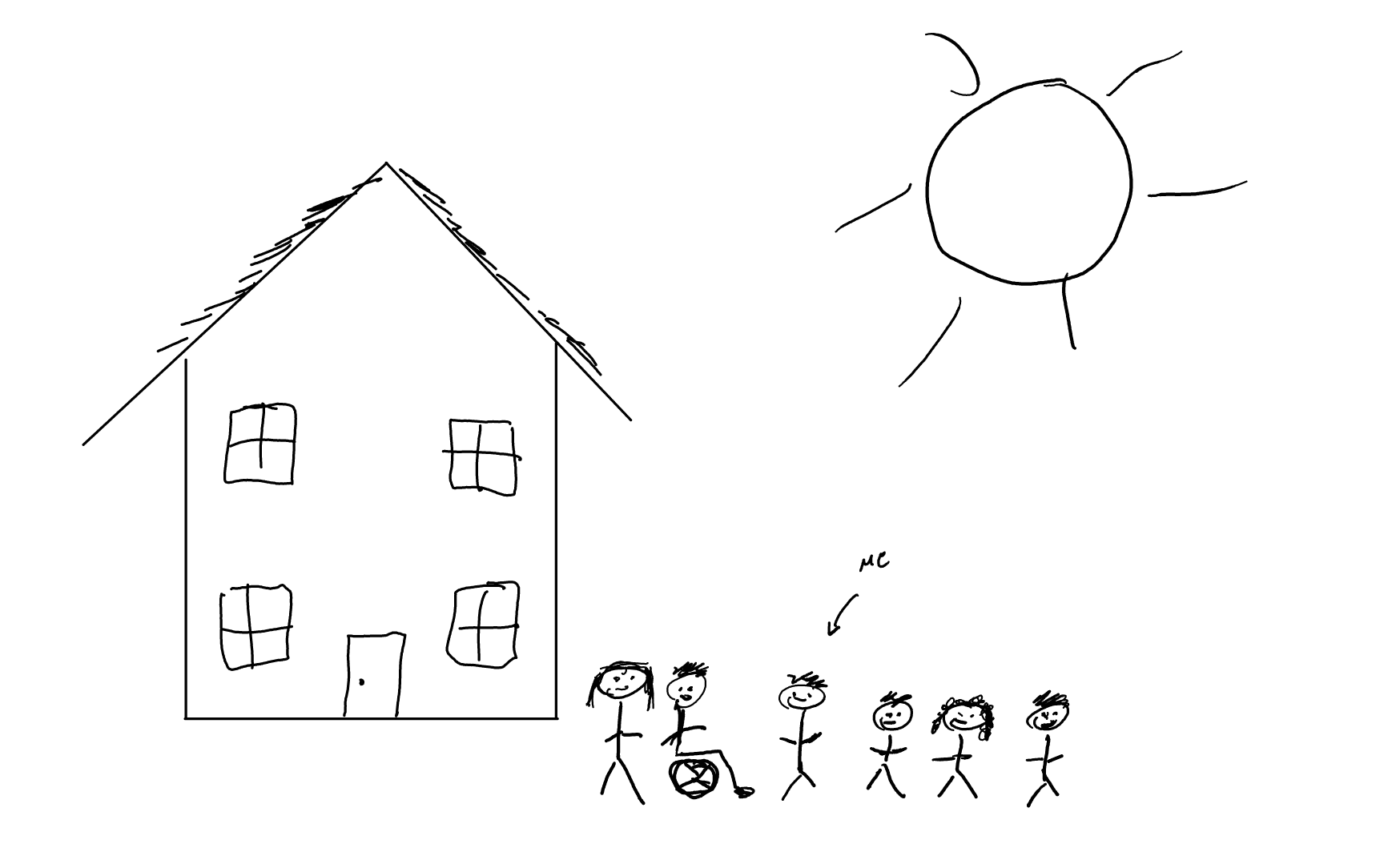
For me, for most of my life, my "family" looked like this:
This is my mom, my dad, me (since I'm the oldest) and my siblings (as you can probably tell they're triplets). Depending on the period, there may have been a dog or two, maybe a half dozen parrakeets, but otherwise that was it. Grandparents, aunts, and uncles were relegated to "extended family".
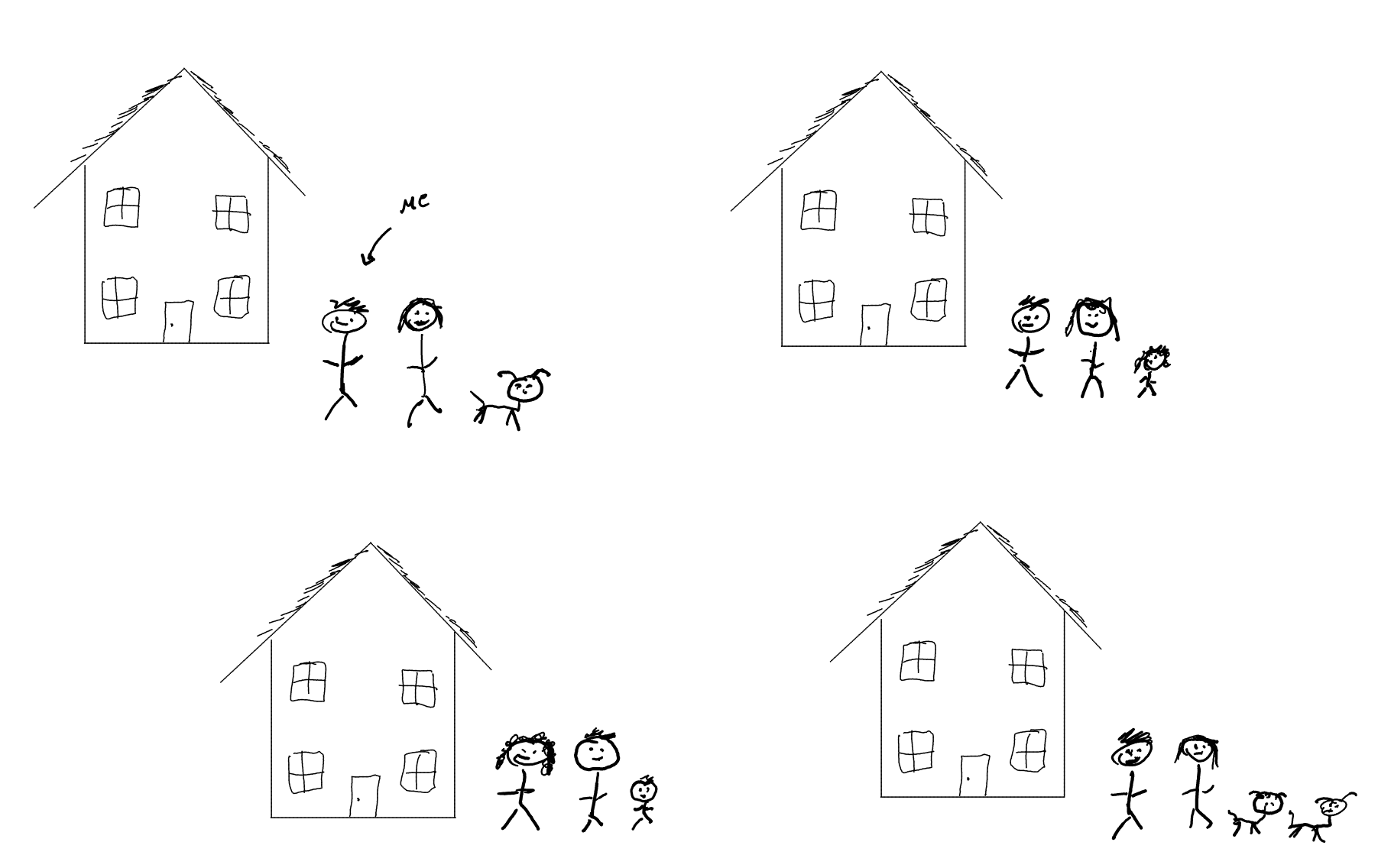
But my sense of family has started changing. It's changing still. My new image is looking something closer to this:
My family is Megan and, for the moment, our puppy Millie. My siblings also have their own newly formed families. One is married, two are having kids with their respective partners, and all three within the last 12 months have become homeowners. We each have a family of our own and so, in the eyes of me just a few months ago, we've each been relegated to each others' "extended family".
What's weird to me about all this is that I never thought to ask my parents or my siblings about this before. I never asked them all to draw what they saw their "family" to be because I assumed it would look like mine. Nowadays I'm less sure. Maybe my parents' image never looked like mine. It's possible that once you reach this stage the frame expands and whatever the next generation sees as "extended" is just your version of "family".
Kenny Peng (together with Erica Chiang, Sophie Greenwood, Jon Kleinberg, and Nikhil Garg) proposes a new design for social media: rather than feeds—where there's only one direction to move in—a better design would facilitate trails.
The premise of the project—that social media should let us actively traverse it through connections between items, rather than passively scroll a feed—feels exactly right, and I hope to see the idea gain traction.
What I want to push on in this reply is not the premise but the analogy. Trails is one of many analogies that build toward a more connected online space. I wonder whether others might better achieve the aims Kenny and his colleagues set out.
When I think of trails, I think of the woods. I imagine carved out paths, either deliberately by some trail designer or organically through many feet following in each other's footsteps. Trails can be social in this way—you go where others have gone before. But trails are often lonely places too; you can walk a whole day without another person in sight. And should you tread your own path, you may end up somewhere no one else has gone before.
Online trails can have a similar property. If you were online in the early 2000s, you're likely to remember the site StumbleUpon, a site designed for serendipity. You'd press a button to "Stumble!" and the site would send you to a random webpage. You could pick your interests and provide a Thumbs Up or Thumbs Down for the pages you were sent to so that the platform could learn your taste to serve you better "stumbles" in the future. This was a site designed with trails in mind and indeed like the physical trails in the woods, once you stumbled in one direction, you could wander for hours. Wikipedia is another example where you could start in one place and tread a path to somewhere you were not expecting. We refer to following trails of this kind as going down a rabbit hole but notice that we rarely go down rabbit holes together; rather, they're something we tend to do alone.
I worry social media designed to mimic trails will emphasize this tendency. We'll be able to move in more directions than one, but the experience will leave us feeling less connected rather than more.
The worry is not intended as a dismissal of their ideas. I think Kenny and his collaborators are onto something deep. StumbleUpon was wildly popular for reasons that social media today doesn't quite capture. Trails, as they've proposed it, enable us to wander further into topics that capture our imagination in the moment. Like StumbleUpon, online trails transport us somewhere else for a moment. The reference at the end of Kenny's post, of Alice in Wonderland with the locked doors in the long hallway, is apt—trails give us individual rooms to explore. The tool they built (http://www.skytrails.org/) captures this perfectly; when I used it a few weeks ago, it felt exactly like peeping into different rooms to see what was happening. But each trail felt discrete. Following one trail might lead you somewhere no one has gone before, but I didn't feel more connected to others as a result. And, like the trails of the world, there's a risk of getting lost.
So what's an alternative analogy? I think it's an experience that builds on Kenny's premise that social media should be designed so that users could actively traverse it using connections between items, while retaining the social part of social media. If we're sticking to the outdoors, this would be more akin to the campground than the trails, a place where folks come together with friends and strangers alike and where jumping from one conversation to another is more fluid.
What I want is an online public space. If not a campground, then a piazza or a beach or a public park or a mall. Somewhere where one can be part of a conversation while close enough to others to overhear what's going on. These are not individual rooms to peek into but an open space. A space where the norms leave one feeling welcome to hop around and join in on other discussions. Where two groups can easily merge if they find themselves on similar topics and just as easily disband when the conversation runs its course. Like public spaces of the past, they'll bring together a mix of people, many of whom are familiar—not strictly friends but also not total strangers.
As Kenny and his collaborators point out, the technology that allows us to build this is here and I'm so glad they are motivating this discussion. I can't think of a better group to be thinking alongside. The premise of what they're building feels right. It's the analogy they've chosen that I worry could lock us into a solution that doesn't fully address many of the challenges with social media.
It's no coincidence that Eli Pariser, who wrote the book that introduced the world to "filter bubbles," has since turned his attention to building thriving digital public spaces. In his book on filter bubbles, Eli is clear about the friction social media introduces in society: 1) we're increasingly enclosed in our own filter bubbles, which makes it harder for individuals to see things from others' point of view and 2) we're each living in parallel but separate universes with a quickly diminishing set of shared facts.
From these ideas, it's easier to see why the analogy of trails may fail to relieve us of the feeling that we're trapped in our feed. To break out of that I think we need more of what Cass Sunstein, in #Republic, argues are tenets of a well-functioning society: 1) people should be exposed to materials that they would not have chosen in advance and 2) many or most citizens should have a wide range of common experiences. How then do we build online platforms that facilitate this?
Trails have the potential to disrupt filter bubbles by enabling users to browse more freely; to follow a path from an idea and come across views they would not have chosen for themselves. I love the prospect of being able to move in many directions and trails certainly allow for that. But something is lost when we wander too far from camp. In a world that's increasingly isolated, I wonder if the design of the future can somehow be more connected.
On Friday, Anthropic Labs released a preview of Claude Design, an entirely new way to interact with Claude to create visual work like "designs, prototypes, slides, one-pagers, and more." The video blew me away. It's so cool!
Claude DesignAIacademic researchspeculative design
Then I tried it. The actual product, used to redo a few slides, was underwhelming.
Nevertheless, Claude Design exposes a path for a company like Anthropic to truly disrupt the academic system as we know it.
Let's imagine another product entirely, but with the academic researcher in mind. I'll call it Manuscript.
A set of notes I gathered between the summer before starting my PhD and the end of my first term, drawn from conversations with mentors and older students. As with the many bits of advice you will receive, I hope you take what makes sense to you.
Treat the first couple of years as an apprenticeship. Embrace a beginner's mind. Attend seminars and meet with visiting researchers. Reserve time to learn new skills. Overweight courses in research design and analytical methods. Meet with faculty early. Be transparent and clearly communicate intentions and expectations. Do not take on too much. Come up with a ton of bad ideas. Remember, you are not in this alone. With thanks to Sendhil Mullainathan, Jane Risen, Anuj Shah, and Abigail Sussman.
No notes match your search.
New notes are published on Leaflet. Follow along there for updates and to join the discussion.